Thursday, April 28, 2016

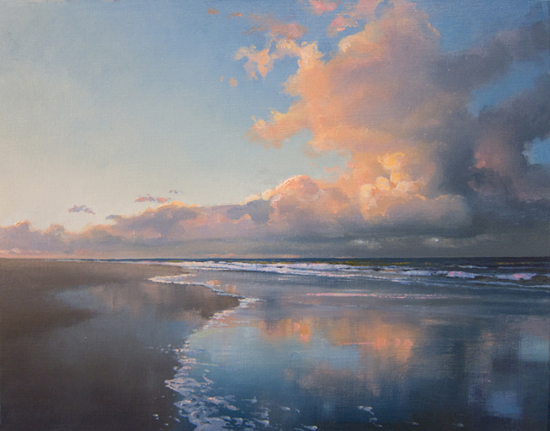
Evening Clouds

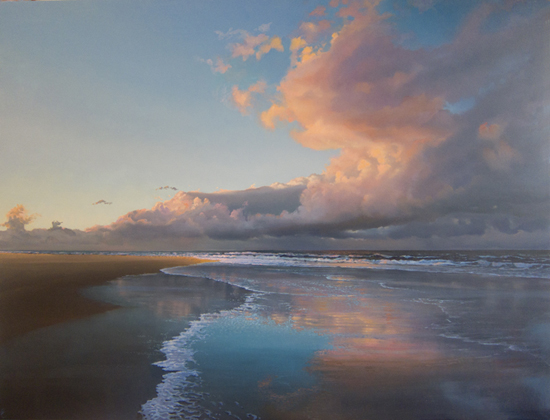
Maybe you remember the oil sketch I told you about in my March 31 blog entry. I just finished  a large size painting on panel after that sketch. Funny, the sketch (30 x 40 cm) took me only a few hours, but the panel painting (90 x 120 cm) took me about three weeks...   I made a short video of the different stages of the painting. Hope you enjoy it!


Evening Clouds (oil on panel, 90 x 120 cm)


Thursday, April 14, 2016

The importance of composition #2

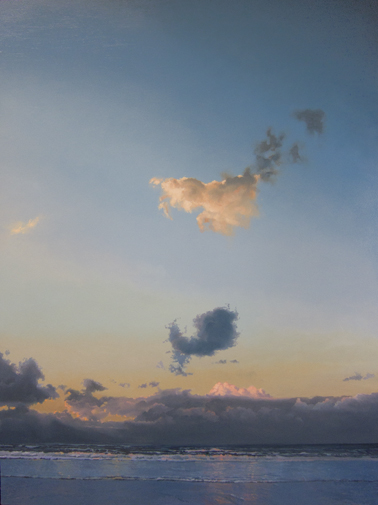
Since my last blog entry I finished a painting called 'Little Evening Cloud'. It has a few similarities with the previous painting I made (blog entry March 31), but also a number of differences. This one is dominated by strong horizontals, not only in the horizon itself (surprise), but also in the clouds directly above it and in the sea. And though it's not exactly symmetric, it smells like symmetry. In contrast to this the previous painting is a-symmetric and has strong diagonals. Take a look.

Little Evening Cloud, oil on panel, 120 x 90 cm


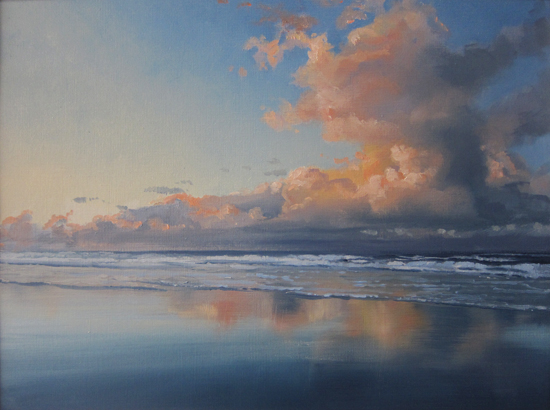
Evening Clouds, oil on paper, 30 x 40 cm

What's the visual effect of these differences? Movement. The Little Evening Cloud is stable and quiet, while the oil sketch is dynamic and has more depth. Some theoretics claim that realist art has benefited greatly from abstract art. They might have a point. Concepts like composition, rhythm and negative shapes became part of the world of realist art only after the twentieth century abstract movement. Even a painter like me owes a lot to Mr. Mondriaan. Funny, eh?  


Thursday, March 31, 2016

The importance of composition

A couple of days before Easter I finished an oil sketch of a beach with evening clouds. It was the second time I worked on it, after telling myself it was finished. It wasn't.

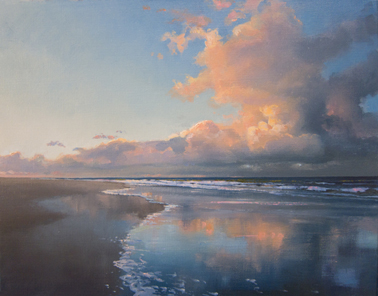
Here's the first version.


And here's what it looks like now.

Evening Clouds, oil sketch on paper, 30 x 40 cm

I wondered what made me want to change it. I mean the light was okay, the reflection too, but something was a bit boring. I decided it was the composition. In the first version the movement to the left is very dominant, predictable even. In the second version the land wash makes a counter movement that interrupts the symmetry of the clouds and their reflection. As a result the viewer's eye is drawn into the distance. Cool, eh?

A symmetric composition has it's advantages. It's balanced and it's stable and the different elements are automatically tied together. But if you're out for a more dynamic image symmetrie is a bit of a challenge and you got to find other ways to unify the composition. The answer is often found in rhythm. The repetition of a shape or direction, but with a slight difference. In this case the land wash is an echo of the shape of the cloud.

Do I think about this kind of stuff when I'm painting? No, I don't. But when I step back and something bothers me, an analytic approach can be very useful. Painting is not only expression an emotion, it's sometimes rational and analytic as well. You gotta use everything you got!

Friday, March 18, 2016

Painting without a plan #2

In my last blog entry I told you about the process of making a painting without a plan. I thought it was finished, but the thing has a mind of it's own. All I could do was listen en so I began working on it again. This is what it looked like 14 days ago:


And here's what it looks like now:


Morning, oils on panel, 90 x 120 cm


Spot the differences! 

- I reworked the cloud at the horizon. I felt it needed more detail and the edge of the cloud repeated the contour of the dune, which started to annoy me. Softened the edge by adding a yellow glaze on top of the blue  bottom layer. Lightened up the cloud too.
- I felt the composition was out of balance. Too much happening on the left side, so I added a bunch of fluffy clouds on the right side which also put more emphasis on the composition's focal point, the tip of the dune.

Now that I see them together on the screen, I'm not sure if the changes are all for the better... I think the clouds on the right are an improvement. Don't know about the rest.

Let me know what you think!  

Friday, March 4, 2016

Painting without a plan

In one of my Top Ten painting tips (blog entry May 5, 2014) I quoted a fellow painter who said: "Failing to plan is planning to fail". I agree. He's right. Problem is I have another rule that says: "You need to break your own rules every now and then". And of course there is Leonardo da Vinci, who advised painters to look at old, weather-beaten walls, to sharpen their imagination. Much like kids look at clouds and see elephants and castles.

A few weeks ago I really felt like painting without a plan. I had a 90 x 120 cm panel, paint, brushes, everything you need to make a painting. I mixed a lot of soft blue and covered the panel with it. Sadly I forgot to take a picture of this first stage. Then I decided where my horizon would be and painted a slightly darker color above and below it. Immediately it looked like the reflection of a band of clouds. The fun of the whole thing is that you start seeing things in what is basically a surface covered with paint. By coincidence the right side of the painting was a bit darker than the left side and I imagined a dark cloud coming in. In this first stage everything is done wet-on-wet and with big flat brushes, so called spalters.

I won't bore you with every single step of the process, but in the end, the cloud disappeared, a dune popped up and I had a great time. The final image was (in my mind) a picture of an early morning with soft light coming through.

You should give it a try. If you do, let me know!


Morning, 90 x 120 cm, oil on panel

Friday, February 19, 2016

Win-win

A lot of artists are also collectioneurs. They fully know how to appreciate the work of a fellow artist. What it takes to make a piece, the hard work, the thinking, the frustration and in the end the satisfaction (or the trash). Artists are very often admirers. But sadly most artists have the taste, but not the money. We can't afford our own work, let alone that of our colleagues.

But we found a way around this problem. We swop.

Centaur, 2011
bronze
45 cm

This is my latest gain. A really marvelous 45 cm bronze by Dutch sculptor Karel Zijlstra (http://www.karelzijlstra.nl). I knew and loved his work, but didn't know him personally until we decided to exchange pieces in 2013. For all kinds of reasons it took us almost three years to close the deal, but we kept in touch and in the meantime developed a friendship. Last January the exchange took place and it was a perfect example of a win-win situation.

Now I have the privilige of admiring this exquisite Centaur on my living room table and Karel has a beach scene, with which (and I quote) he is 'super happy'. Win-win.

Narrow Beach, 2015
oil on panel
50 x 150 cm


Friday, February 5, 2016

The fat-over-lean rule

When I received my training in the late sixties at the Minerva Academy I got to paint with oils for the first time. I loved it from the very beginning. It's a fantastic material, with endless possibilities. No other paint, be it acrylics, water colors or alkyds, comes close to oils, as far as I'm concerned.

Reflection #3,
oil on panel,
15 x 45 cm
One of the things we learned was the fat-over-lean rule, which meant using terpentine (lean) in the bottom layer and oily media like linseed oil (fat) in the upper layers. This was to prevent dull spots in our paintings. Something to do with one layer absorbing oil from another layer, I don't know. Ofcourse I always had dull spots and had to apply retouching varnish to add medium to the spots.

Oil paint takes ages to dry. I found it hard to wait long enough before applying the next layer and I ruined more than one painting with my impatience. In the end I worked on several paintings at a time, just to give each one sufficient drying time. There was another solution, which meant adding a siccative to your medium, a substance that shortened drying time considerably. But in the long run, our teachers told us, this would have a catastrophic effect on the colors of our paintings. I don't know if that was true, I never put it to the test. I used to listen to my teachers...

With the new media (like Liquin) all these problems are over. The fat-over-lean rule doesn't apply anymore. Liquin is a petroleum distillate and not a fat, it's fat nor lean. On top of that it dries real quick. I don't have to work on more than one painting at a time anymore. Long live chemistry...

If you want to learn more about my painting technique, please go to www.paintingskies.com/video.