After I finished my studies at Minerva Academy, sometime in the early seventies, I sort of gave up painting. I wanted to make music and that's what I did. I even quit my teaching job to be a full time musician. But when the band I played in hadn't made it to world fame after a few years, it split up and I went back to teaching.
It wasn't till 1996 that I started painting again. Felt a sudden and deep urge to pick up my brushes and I didn't put them down ever since. After some time I wanted to show the world what I made, so I started looking for galleries. The internet was not yet in full swing, so I wrote letters with one or two pictures of my work. If I was lucky I got a rejection letter, but very often not even that. Sometimes (if I felt confident enough) I picked up the phone to make an appointment with a gallery owner to show my work. I made quite a few miles with paintings in the trunk of my crappy car. Every now and then I got lucky and after a few years my work started selling. In 2004 I quit my teaching job for the second time and I've made a living doing what I love best since then. Feel really blessed.
 |
| Beach poles, oil on panel, 70 x 100 cm |
Trying to get a gallery to show your work is one of the more unpleasant aspects of a painter's life. Still you have to put in the hours, again and again. Here are a few tips that may help:
- Before you get in touch with a gallery do some research. Find out about their artists and how you fit in, or more precise, what your work will
add to the gallery. 'What's in it for me' is a common question for a lot of people and gallery owners are just like people
. They want to know what your work will add to their business.
- Never barge in on a gallery owner unannounced. They hate that, they feel ambushed and your chances are reduced to practically zero.
- Try to think of a strategy. I often sent an email to a gallery, announcing that I would send them a book on my work. This gave me a reason to contact them again, had the book arrived? Have a number of questions prepared. When you got a conversation going, your chances are growing.
- Don't overdo it. It's frustrating work and you got to spread your frustration thin. Painting is to much fun to let it be ruined by gallery rejections.
If you have a story to share about your search for galleries, please let me know!
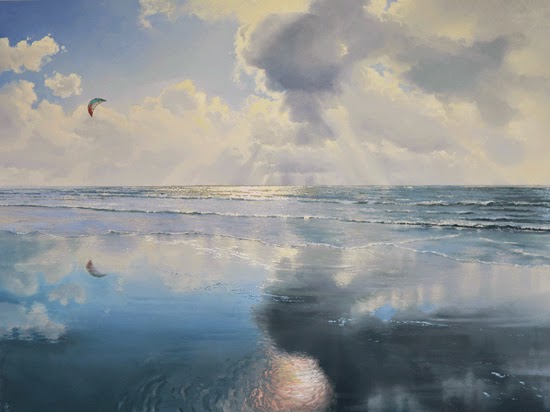

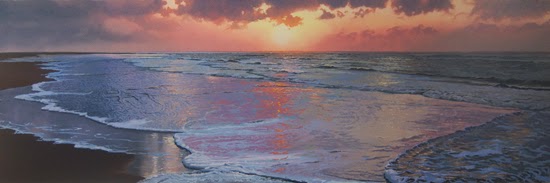
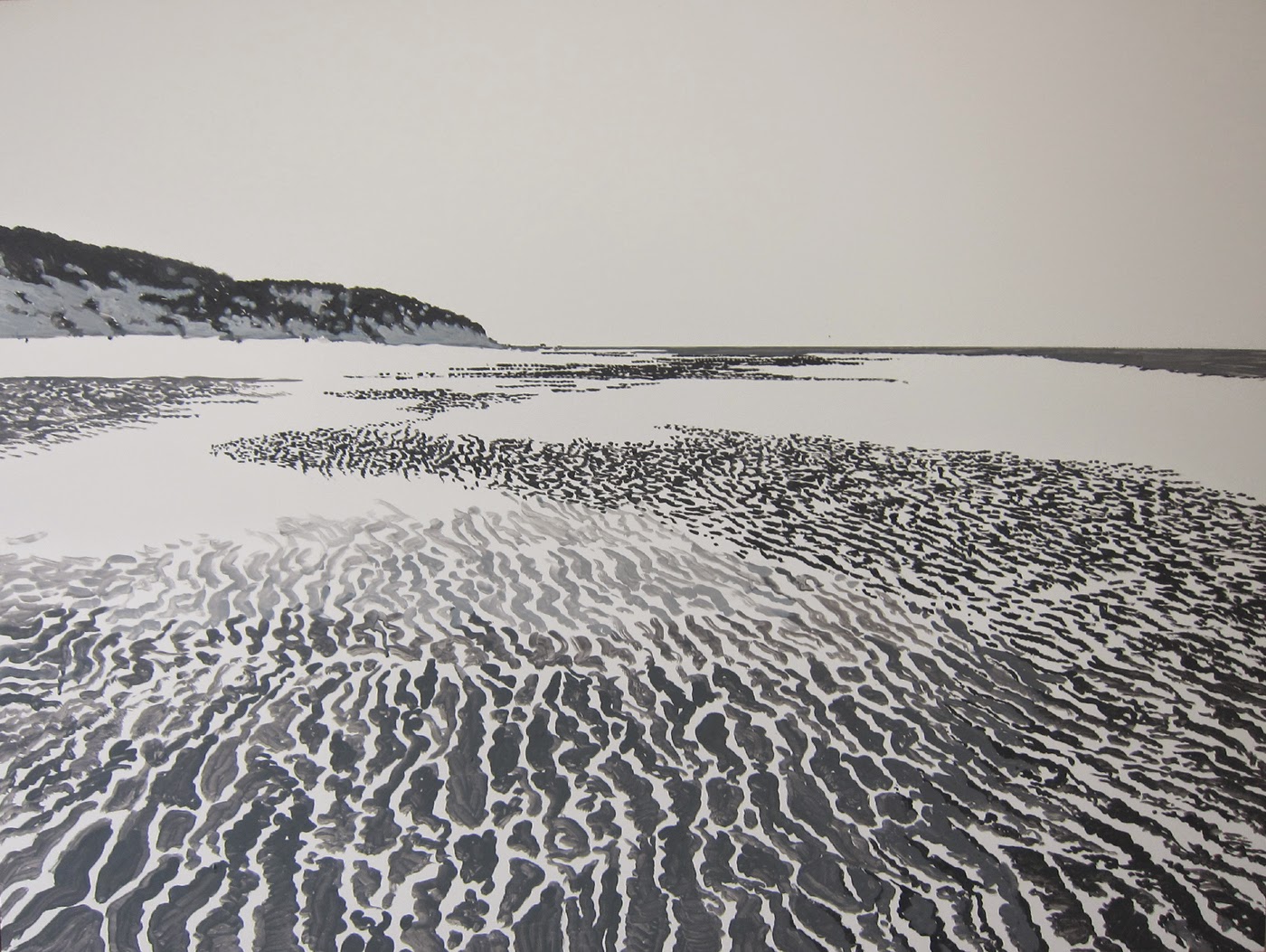 By doing so he was able to tackle the problems of volume and composition, without having to bother about color. In combination with glazing (to apply your colors) it's a really powerful tool. It gives you maximum control, because you build up your painting step by step. It takes a lot of planning and patience though. If you're the 'I-have-to-spontaneously-express-my-feelings' kind of painter this is probably not the right technique for you.
  In my painting After the Storm I was very keen on getting the structure of the sand right, so I painted it in detail with black and white acrylics. Then I slowly built up my colors with oils. Even though the black and white structure almost disappeared in some areas, you can still see it shimmering through the top layers. On your computer screen there's probably not a lot left. That's what happens when a painting of 90 x 120 cm has to fit on a laptop screen...



 Got several emails with questions about the surface I paint on. The short answer is: 6 mil. MDF panel, mounted on a wooden frame to prevent curvature.
 The long answer is: I used to paint on canvas, but the texture of the fabric started to bother me. I wanted the decision to be up to me, wether I needed a smooth or a textured surface. So I started painting on wood. I used to prepare my own (masonite) panels. Grounded them with Gesso (a Talens brand) and a brush. Watered the Gesso down in the first three, maybe four layers. Less water in each following layer and you avoid "gumming-up". I used very fine sandpaper to smoothen each layer, always with lots of water. To speed up the drying process I had a hair dryer on stand by. To tell you the truth: I hated it, it was an awful lot of work. The results were great though.