Thursday, May 28, 2015

Solo show at 'De Twee Pauwen' Art Gallery

Last Sunday was an exciting  day for me. My fifth solo show at 'De Twee Pauwen' Art Gallery opened. De Twee Pauwen (The Two Peacocks) is a beautiful gallery in Den Haag center, close to the Royal Palace. The weather was great, lots of sunshine, hardly any wind. No gallery-weather at all. Gallery owners like a clouded sky and wind.

Anyway, despite the beautiful weather, the turnout wasn't bad at all, the music and the sales were great and I had a really good time. I've been working my boots off these last few months and this was my reward. Check the recent work section of my website for an overview of the exhibition.

Here's a short impression of the event.


Friday, May 15, 2015

Reflections video online

In the last few months I kept you posted on the new video we were working on. We started back in January and now it's finished and available at www.paintingskies.com/video.. Can't help but to feel a little proud...

Step by step I take the viewer through the painting process, from a blank panel to the finished work. The subject this time is painting reflections. To quote myself: "Painting reflections isn't exactly easy but it's no rocket science either. You just have to observe a few ground rules."  

Every now and then the video wanders off to images of the island that has been the inspiration for many of my paintings, the Wadden Sea island Vlieland. It has been of great importance to my life and my work, going back to the drawings I made there as a five year old.

 Here's the YouTube trailer. Let me know what you're thinking!


My dear friend Theo van Egeraat shot the video, just like he did the previous one. Beautiful footage, with a sharp eye for the painting process.

The music was composed by Udo Pannekeet, one of the best contempory Dutch bass players. His music, with the warm sound of his fretless bass, takes the video to another level.

The finished painting will be part of my solo at De Twee Pauwen Art Gallery in The Hague (Netherlands) from May 24 - July 7, 2015. 

Friday, May 1, 2015

Varnishing-day

Been working hard for my solo show next month in The Hague (Netherlands). Beautiful gallery in the old center, close to the Royal Palace. Projects like this are very inspiring. The final painting is almost ready and now it's time for the stuff that I don't like. Varnishing for example.

I carefully read the weather forecast when planning 'Varnishing-day'. Temperatures have to be mild (and that can be a problem during Dutch spring), little wind, no rain. When the day arrives I open all the doors and windows, take a deep breath and go for it, hoping the draft will chase the fumes. In the past I sometimes wore a face mask, but I had trouble breathing, wearing it.


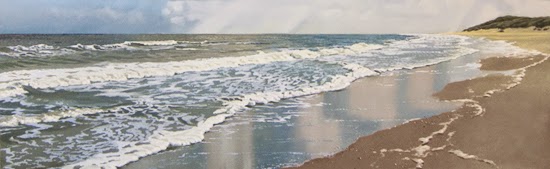
Beach with Tyre Tracks, oil on panel, 50 x 150 cm

There is an infinite number of varnishes on the market today, but basically, there are two kinds for oil paint: retouching varnish and finishing varnish. You got to wait at least a year before applying a finishing varnish (oil paint takes forever to dry), so most of my paintings leave the studio with just a layer of retouching varnish. No problem.

Retouching varnish comes as a glossy varnish only, and I don't want the surface of my paintings to shine like a mirror, so I add terpentine or white spirit, up to 30%. I use a broad hog hair varnishing brush and a small paint roller to add a fine texture to the the surface.

Windy Beach (excision), oil on panel, 90 x 120 cm

Once the job is done, I quickly forget the smell and the fumes. Colors are intensified and I like the satin gloss. But the best moment is yet to come, when I enter the gallery and see the work in the great setting of De Twee Pauwen Art Gallery. From May 24 - July 7.

Want to see more of the work I did for this exhibition? Check www.paintingskies.com.

Thursday, April 16, 2015

Reflections, the video #2

In my February 5 blog entry I wrote about the new long video we were shooting. Well, the painting is finished and we did a first edit. Next step is the voice over and of course the background music.

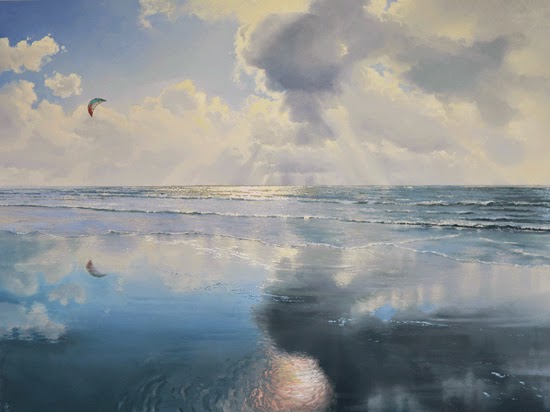
I hope it'll be online sometime in May. Here's the painting.

Reflections, 120 x 90 cm, oil on panel

That's all for now. Busy. More in two weeks!

Thursday, April 2, 2015

How to get a gallery

After I finished my studies at Minerva Academy, sometime in the early seventies, I sort of gave up painting. I wanted to make music and that's what I did. I even quit my teaching job to be a full time musician. But when the band I played in hadn't made it to world fame after a few years, it split up and I went back to teaching.

It wasn't till 1996 that I started painting again. Felt a sudden and deep urge to pick up my brushes and I didn't put them down ever since. After some time I wanted to show the world what I made, so I started looking for galleries. The internet was not yet in full swing, so I wrote letters with one or two pictures of my work. If I was lucky I got a rejection letter, but very often not even that. Sometimes (if I felt confident enough) I picked up the phone to make an appointment with a gallery owner to show my work. I made quite a few miles with paintings in the trunk of my crappy car. Every now and then I got lucky and after a few years my work started selling. In 2004 I quit my teaching job for the second time and I've made a living doing what I love best since then. Feel really blessed.

Beach poles, oil on panel, 70 x 100 cm

Trying to get a gallery to show your work is one of the more unpleasant aspects of a painter's life. Still you have to put in the hours, again and again. Here are a few tips that may help:

- Before you get in touch with a gallery do some research. Find out about their artists and how you fit in, or more precise, what your work will add to the gallery. 'What's in it for me' is a common question for a lot of people and gallery owners are just like people. They want to know what your work will add to their business.
- Never barge in on a gallery owner unannounced. They hate that, they feel ambushed and your chances are reduced to practically zero.
- Try to think of a strategy. I often sent an email to a gallery, announcing that I would send them a book on my work. This gave me a reason to contact them again, had the book arrived? Have a number of questions prepared. When you got a conversation going, your chances are growing.
- Don't overdo it. It's frustrating work and you got to spread your frustration thin. Painting is to much fun to let it be ruined by gallery rejections.

If you have a story to share about your search for galleries, please let me know!

Thursday, March 19, 2015

Perfect?

Got an email from Christian from Germany. He saw my Painting Clouds video and wrote some nice things about it. I can never get enough of that. Very encouraging.

In the correspondence that followed the topic was perfectionism and how it can hold you back. Christian wrote:"..my inner critic slows me down or prevents me from doing anything at all". Attached to his mail he sent me a cloud painting he made. Looked real good...

Ofcourse it's a good thing to set the bar just a bit higher every time you start a new painting, to set goals and all that kind of stuff. But however much you grow, you'll never be perfect. And that's a good thing. One of the joys of painting is the feeling you're getting better, that over time you've learned to master problems you couldn't handle before. If you could be perfect, you would loose that. Boring.

At the end of a work day I often ask myself: did my painting get better today? Most of the time the answer is yes. If I'd ask myself: did it get perfect today, the answer certainly would be no. You gotta ask the right questions.

Painting is an excellent way to get in a state of flow. For a few hours there's just you and the painting. In 1975 a guy with a funny name (Mihaly Csiksgentmihalyi) wrote a great book about it, called 'Flow'. One of the conditions to enter a state of flow, he writes, is that the task ahead of you may be difficult, but you feel you can do it. In other words: match your challenges to your skills. And do the hours, I'd like to add.

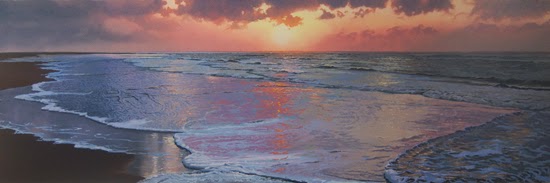
I just finished this sunset. Succeeded to paint the movement of the water, with the little ripples and everything, on top of a ground layer. Tried it before but it didn't really work. I didn't match my challenges to my skills, I guess... 

Sunset, oil on panel, 50 x 150 cm

Friday, March 6, 2015

Grisaille

Some of the painting techniques I use have a long history. Glazing for example (where you paint transparent layers on top of each other) dates back to the 15th century. In my Painting Clouds video I explain what it meant to me when I first learned about it. 

Another technique I sometimes use is the 'grisaille'. The French word 'gris' means grey and that kind of sums it up. The painter limits his palet to black, white and grey. A lot of 15th century triptych doors have a grisaille of a saint at the back. In the 16th century it was Leonardo da Vinci, I think, who was the first to use the grisaille as an underpainting. 

By doing so he was able to tackle the problems of volume and composition, without having to bother about color. In combination with glazing (to apply your colors) it's a really powerful tool. It gives you maximum control, because you build up your painting step by step. It takes a lot of planning and patience though. If you're the 'I-have-to-spontaneously-express-my-feelings' kind of painter this is probably not the right technique for you.  
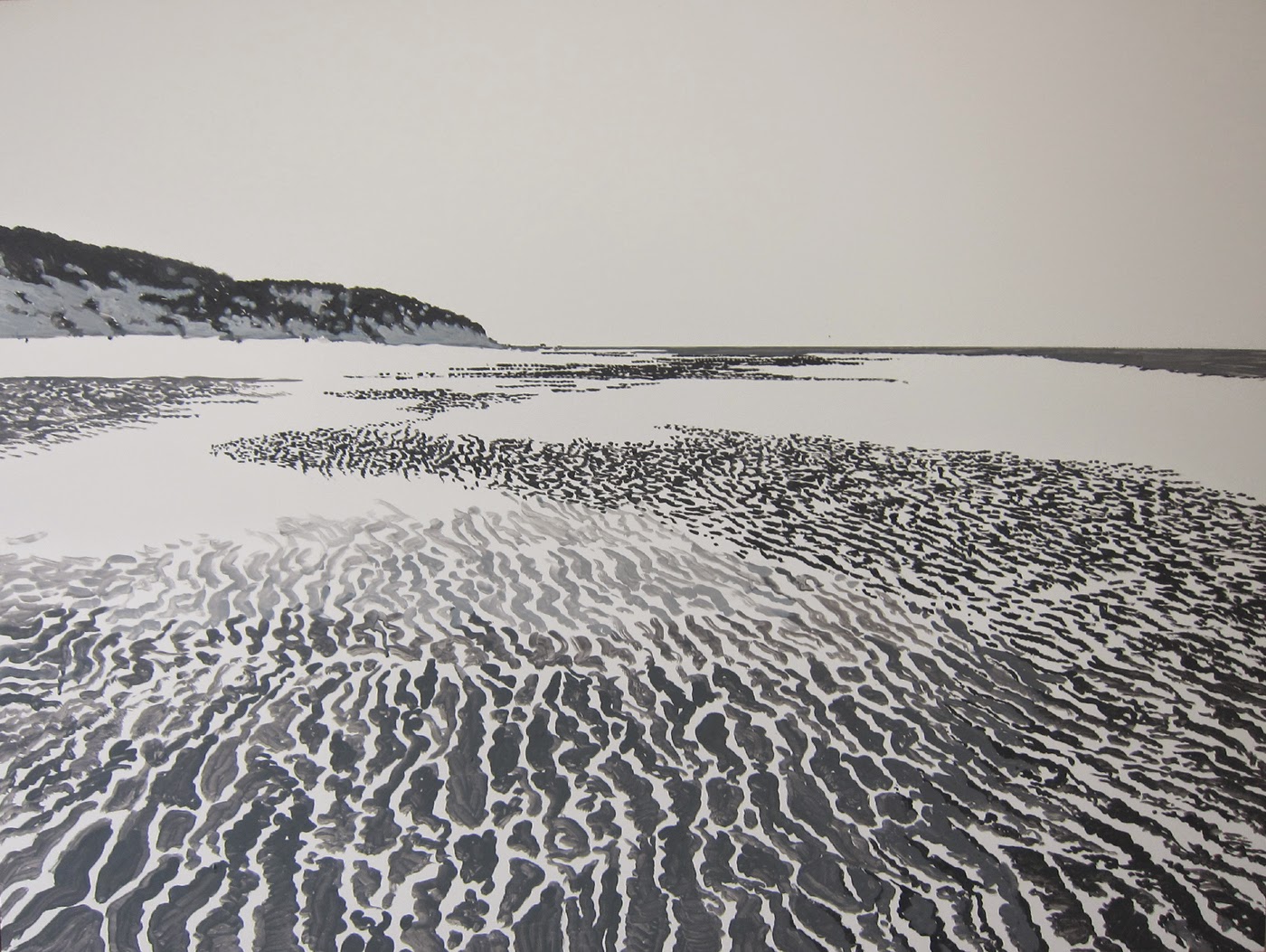
In my painting After the Storm I was very keen on getting the structure of the sand right, so I painted it in detail with black and white acrylics. Then I slowly built up my colors with oils. Even though the black and white structure almost disappeared in some areas, you can still see it shimmering through the top layers. On your computer screen there's probably not a lot left. That's what happens when a painting of 90 x 120 cm has to fit on a laptop screen... 
Anyone tried this? Let me know!